
Movie posters have undergone a significant transformation over the past century, evolving from mere advertisements into sophisticated works of art.
While early posters were predominantly text-heavy and resembled newspaper advertisements, the widespread adoption of color lithography in the early 20th century enabled more vibrant and visually engaging designs, including hand-drawn portraits of film stars.
During Hollywood’s Golden Age, cinematic posters became recognized as an art form, featuring bold graphics, striking typography, and Art Deco influences with an emphasis on character-focused imagery. Naturally, regional differences emerged depending on the country of origin.
Later, during the 1960s, a paradigm shift influenced by counterculture and pop art led to more experimental and abstract designs, including photo montages. Simultaneously, the birth of blockbuster marketing began prioritizing mass appeal in poster aesthetics.
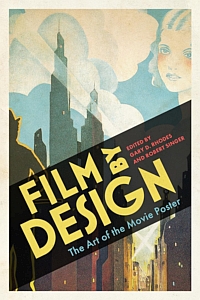
Film by Design: The Art of the Movie Poster explores the intricate and evolving role of movie posters in film history and cultural perception, emphasizing their artistic, commercial, and sociopolitical dimensions. “Movie posters are cultural texts that serve as gateways into the world of the film, offering viewers a first impression that often lingers long after the credits roll.”
The title comprises twelve chapters, each delving into a different aspect of the theatrical poster’s evolution, cultural impact, and symbolic meanings. It spans diverse geographic, cultural, and temporal contexts, illustrating the universal and timeless nature of posters as visual texts.
Themes are as diverse as provocative imagery and censorship in US posters of the 1930s; poster art from India, Africa, and Cuba; the early US environmental movement in film advertisement; psychological themes and creature horror in promotional artwork; and a chapter on one particular Fritz Lang movie and its various national representations. For example, editors Gary D. Rhodes and Robert Singer stress the concept of the “paratext,” which encompasses items that surround and influence the perception of a film without being a part of the film itself.
They provide examples like Dr. Jekyll and Mr. Hyde (1931) and Madame Hyde (2017). Provocative imagery and censorship concerning US poster art from 1916 to 1934 are the subjects of Chapter 2, which demonstrates how artists navigated the tension between creative expression and the constraints of the Hays Code; in turn, the effect of censorship shaped a sophisticated visual language.
Other highlights include Madhuja Mukherjee’s essay on song booklets, lobby cards, and posters from the 1930s to the 1960s for Indian cinema. These materials acted as cultural artifacts that extended the cinematic experience beyond the theater; they created a shared cultural experience, which helped forge community and identity. “The use of cultural and mythological symbols in Indian film posters helped forge a deep connection with audiences, transforming them into cultural artifacts with lasting significance.”
Postcolonial melancholia is addressed by Vlad Dima, who muses on identity, themes of displacement, longing, and resistance by presenting artwork for Black Girl (1966) and Touki Bouki (1973). Dima argues that the melancholy captured in these posters is not merely a reflection of loss but also a form of resistance, articulating the ongoing struggle for identity and belonging in a postcolonial world.
Another very informative contribution comes from Frank Percaccio, who compares two similar yet distinct types of ‘creature features’—namely, the posters for Guillermo del Toro’s The Shape of Water (2017) and Jack Arnold’s Creature from the Black Lagoon (1954). This chapter focuses on interspecies romance in general and challenges conventional notions of monstrosity. The respective theatrical poster either serves as an invitation to empathy or captures the unique tension between danger and fascination. Even though Arnold’s classic has been the subject of many texts over the years, this is a good read.
Another classic motif, also borrowed from literature, is the Doppelgänger. In this case, the author looks at how Scorsese’s Shutter Island (2010) suggests themes of duality, mystery, and psychological tension. Courtney Ruffner Grieneisen analyzes how its corresponding poster effectively conveys the film’s interplay of reality and illusion, setting the tone for the viewer’s experience where confusion, uncertainty, and permanent doubt are intended. As, for example, the “… lighthouse in the Shutter Island poster functions as a beacon, suggesting the possibility of illumination while also hinting at the perilous journey needed to reach it.”
Fans of film noir will particularly like Chapter 11. Here, Marlisa Santos examines posters of classic genre productions, such as The Big Sleep (1946) by Howard Hawks and Hitchcock’s Vertigo (1958). The use of spirals, shadows, and chiaroscuro lighting visually reflects the genre’s themes of psychological complexity and moral ambiguity. The conclusion notes the lasting influence of film noir posters on contemporary design, showing that these motifs continue to shape the visual language of suspense and psychological drama.
The final chapter analyzes Fritz Lang’s masterpiece Human Desire (1954) and its portrayal of the primal nature of human relationships. “The intense gazes and tightly framed faces in the Human Desire poster suggest a claustrophobic and volatile relationship, emphasizing the film’s themes of passion and jealousy.”
The poster’s use of extreme close-ups and looming shadows conveys the film’s themes of passion and jealousy, epitomizing the noir tradition of exploring the darker sides of human emotions. Author Singer further compares the posters from various countries, which highlights the slightly different approaches of the poster artists, as each country usually produced its own version. Still, the artworks effectively capture the movie’s exploration of complex human instincts, in line with the film noir tradition.
Film by Design collectively illustrates the multifaceted roles of cinematic posters (82 b&w and color illustrations are featured here), transcending their utilitarian function as mere advertisements to become rich cultural texts that communicate complex narratives, emotions, and ideologies. The evolution of these posters reflects the shifts in societal values, artistic expression, and industrial practices across different eras and cultural contexts. By examining these iconic images, editors Gary D. Rhodes and Robert Singer demonstrate thoroughly how movie posters are deeply interwoven with cinematic history, serving as powerful symbols that capture the essence of those productions and the cultural environments in which they were created.
Other contributions come from Laura Hatry, Alicia Kozma, Lynette Kuliyeva, Frank Percaccio, and Michael L. Shuman. Considering that only a few specific movies are under inspection here, this title adds substantial insight into the significance and requirements of creating a film’s visual first impression, and how major features are selected to represent a production on posters as a marketing tool.
Review by Dr. A. Ebert © 2026
Gary D. Rhodes and Robert Singer (eds.) Film by Design: The Art of the Movie Poster. University Press of Mississippi, 2024, 256 p.
